Showing posts with label grade 2-5. Show all posts

April 29, 2017

Module 14 Poetry and Story Collections

Book Cover:


Book Summary:
Poems about the origami creatures a little boy makes in the book and what he does with them after he makes them.
APA Reference of Book:

George, K. O., & Stringer, L. (2005). Fold me a poem. Orlando: Harcourt.

Impressions:
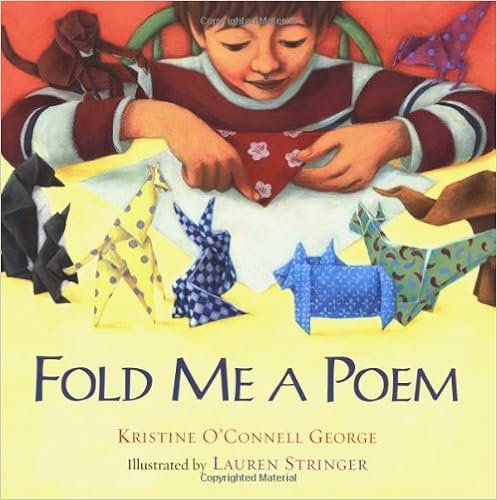
Very simple poems about the origami creatures the boy makes. The pictures are pretty and bright using different perspectives on different pages. Despite being simple text the poems are great and spark the imagination. It feels like the little boy is talking to the origami animals or the reader. I wish that it had how to make the origami animals in the book at the back! It does give you some suggestions for what books to read to learn more.

Professional Review:
K-Gr 2-- George's 32 brief poems focus on a boy as he folds a series of origami animals and imagines their thoughts and possible activities. Some of the selections exhibit a creative spark, while others tend to take their meaning from the illustrations, which are the real strength of the presentation. The vividly colored acrylics depict the boy actively engaged in play with his creations, and the details that Stringer provides infuse the verses with both energy and humor. Her illustrator's note offers insight into her own efforts to master the art of origami. No patterns or instructions are included, although a useful bibliography is appended to guide those wishing to learn the craft themselves.
~~~~~~~~
By Grace Oliff, Ann Blanche Smith School, Hillsdale, NJ
Oliff, G., Jones, T. E., Toth, L., Charnizon, M., Grabarek, D., & Raben, D. (2005). Fold Me a Poem. School Library Journal, 51(3), 193

Library Uses:
You could include this as a read aloud for different poems. Also as an extension you can have students try and fold basic animals.

My Rating: ***
April 24, 2017

Module 13 Graphic Novels and Series Books

Book Cover:


Book Summary:
During the Great Depression Jack and his family are having problems. Jack's sister is sick, he is getting picked on, his dad is upset with him, and there has not been any rain. Jack does battle with a rain monster in the barn (did it really happen or is it dust dementia?) and finally it rains.

APA Reference of Book:

Phelan, M. (2011). The storm in the barn. Somerville, Mass: Candlewick.

Impressions:
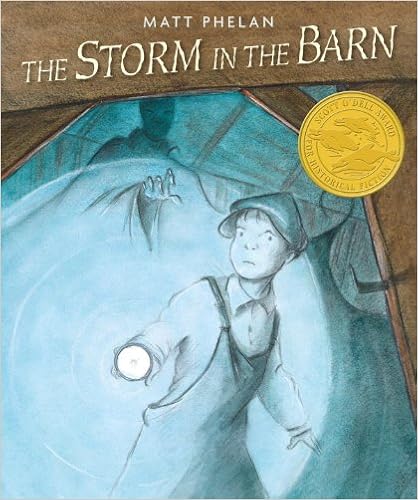
The washed out watercolors of brown, black, grey, orange, and very rarely red help you envision that you are in the past. There is very little text which also gets across the sparseness of the times. Despite that you can follow what is going on. The battle between good and evil is a little dark so I wouldn't recommend this for younger readers. I really liked how this really captured the despaire and feelings of this time in history.

Professional Review:
Gr 5-7--It is 1937 in Kansas, during the Dust Bowl, and 11-year-old Jack can barely remember a world with plentiful water and crops. Unable to help his father with a harvest that isn't there, and bullied by the other boys his age, he feels like a useless baby. Stories offer a refuge, and there are multiple stories in this work. Jack's mother tells about the time when the land was a fertile "paradise." Jack's invalid sister, Dorothy, is readingThe Wizard of Oz, gaining inspiration from the adventures of another Kansan of the same name. Jack's friend comforts him with folktales about a brave man named Jack who masters nature, battling the King of the West Wind, the King of Blizzards, and the King of the Northeast Winds. In the end, Phelan turns the Dust Bowl into another one of Ernie's "Jack" tales when the real Jack encounters the Storm King in an abandoned barn and finds out that he has been holding back the rain. The boy must then gather the strength to determine his own narrative, as well as his parched town's future. Children can read this as a work of historical fiction, a piece of folklore, a scary story, a graphic novel, or all four. Written with simple, direct language, it's an almost wordless book: the illustrations' shadowy grays and blurry lines eloquently depict the haze of the dust. A complex but accessible and fascinating book.
~~~~~~~~

By Lisa Goldstein, Brooklyn Public Library, NY
Goldstein, L. (2009). The Storm in the Barn. School Library Journal, 55(9), 190.

Library Uses:

My Rating:

April 15, 2017

Module 11 Informational Books

Book Cover:
Eat Like a Bear by [Sayre, April Pulley]
Book Summary:
The author takes you through the life of a bear from Spring until Winter talking about the things the bear does and what it eats in short sentences and questions.

APA Reference of Book:

Sayre, A. P., & Jenkins, S. (2013). Eat like a bear. New York: Ed. Henry Holt and Company.

Impressions:
I love the torn paper collages that show the bear as the seasons pass. They are very realistic and add depth to the pictures. There is a lot of repetitive text to help younger readers follow as well as some upper grade vocabulary such as  gnaw, parsnip, and bison. While the non-fiction narrative is about a bear there really isn't a lot of facts in the story itself. At the end there is a two page fact sheet telling you all about grizzly bears. Overall I liked the book not for learning more about bears but as an enjoyable book for fun.

Professional Review:

PreS-Gr 3— Posing the question, "Can you eat like a bear?" this book follows a brown bear as it forages for food throughout the year. Emerging from hibernation in April, the animal sets out on its quest. Each month provides a different delicacy: crispy roots and a ground squirrel in July, juicy huckleberries in September, a stash of pinecones in October. All serve to fatten up the omnivorous creature as it prepares once again for hibernation. The short text is set in a clear, large font and that, coupled with the big, full-color, cut-and torn-paper collage illustrations, makes it a natural for sharing with a group. The mammals themselves are rendered by using handmade Mexican bark paper. Its rough nature gives them greater impact and dimension on the pages. The extensive end notes provide details about the diet of the brown bear, or _I_Ursus artos_i_, its threatened status, and current scientific studies. This additional information increases the usefulness of the title, making it a viable classroom and research tool. That, along with the beautiful art, makes this a first choice for most libraries

Sites, S. L. (2013). Eat Like a Bear. School Library Journal, 59(10), 1.

Library Uses:  
For the younger grades you could use this to sequence months of the year as well as trying the art process of torn paper collages to make animals or other pictures. You could also focus on the illustrators of torn paper collages and do the art activity.

My Rating: ***

April 02, 2017

Module 10 Historical Fiction


Book Cover

Book Summary:
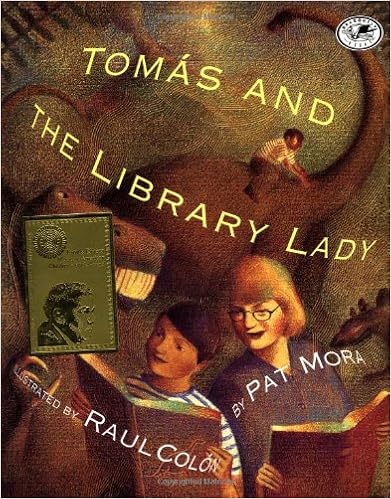
Tomas' family moves from Iowa to Texas to work in the fields. This story tells about how he went to the library and read books given to him by the librarian to read. He would get lost in the books and be able to take some home to read to his family because the librarian checked some out under her name. When it was time to leave he thanked her with some pan dulce and she gave him a new book and a love of reading to remember her by. Later on in life Tomas became a national education leader and professor but still remembered this librarian in Iowa.

APA Reference of Book:

Mora, P., & Colón, R. (1997). Tomas and the library lady. New York: A.A. Knopf.

Impressions:
WOW! This book was powerful in that it shows how just reading a book can transform your life. The librarian went out of her way to make the books accessible to Tomas by checking books out to him under her name and by giving him books that he was interested in. I also like how it shows the spanish/hispanic culture of story telling, food, and family. The pictures with their wood block printing also gave it a "old time" feel but also lent to the culture as well. Living in Texas this should be a staple in any classroom or library!

Professional Review:
Gr 2-4--Tomas Rivera, who at his death in 1984 was the Chancellor of the University of California at Riverside, grew up in a migrant family. Here, Mora tells the fictionalized story of one summer in his childhood during which his love of books and reading is fostered by a librarian in Iowa, who takes him under her wing while his family works the harvest. She introduces him to stories about dinosaurs, horses, and American Indians and allows him to take books home where he shares them with his parents, grandfather, and brother. When it is time for the family to return to Texas, she gives Tomas the greatest gift of all--a book of his own to keep. Colon's earthy sun-warmed colors, textured with swirling lines, add life to this biographical fragment and help portray Tomas's reading adventures in appealing ways. Stack this up with Sarah Stewart and David Small's The Library (Farrar, 1995) and Suzanne Williams and Steven Kellogg's Library Lil (Dial, 1997) to demonstrate the impact librarians can have on youngsters.

Elleman, B. (1997). Preschool to grade 4: Fiction. School Library Journal, 43(10), 105.

Library Uses:
Hmm. Not sure maybe to talk about someone who was important to their reading journey or just talk about what they remember about learning to read and books to now? Maybe favorite book? Or did someone ever recommend a book to you since the librarian gave him a book she thought he would like.

My Rating: I would give this book 4 out of 5 stars!

March 25, 2017

Module 9 Mystery


Book Cover

Book Summary:
In the land of nursery rhymes Little Boy Blue becomes a detective. One of his jobs is to find Little Miss Muffet. So he searches all over town meeting different nursery rhymes until he finds Miss Muffit who doesn't like curds and whey but wants to try porridge.....in the woods!

APA Reference of Book:

Metzger, S., & Arnold, T. (2011). Detective Blue [several different titles found for this book but used this since found on copyright page listed like this]. New York: Orchard Books.

Impressions:

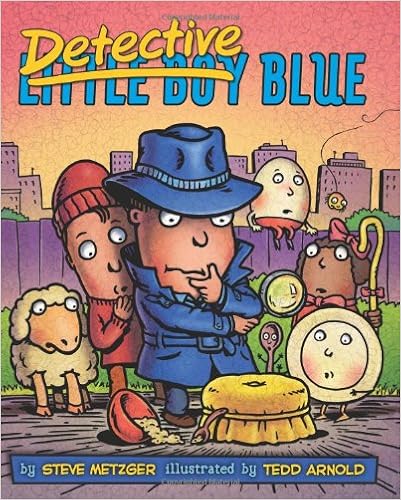
This was a cute easy mystery for young readers who like Fly Guy (same illustrator). The bulgy eyes and bean shaped people are funny looking like in Fly Guy but still not too over the top. It is set up like a graphic novel or comic which is also a format kids love, but they don't tend to read mysteries. I think the graphic novel format will draw them in to reading a mystery. It gives you the basics to a mystery: someone missing or has something missing,  clues, and the solution. Since this story is so simple I would recommend it for kinder through third grade. I also liked the additional I spy aspect in the front to try and find all the different nursery rhymes in the book.

Professional Review:

PreS-Gr 2-- Nursery-rhyme characters take on new, but somewhat familiar, roles in this comic-book-style mystery featuring the dedicated flatfoot formerly known as Little Boy Blue. After a typical day starting with cleaning the dish and spoon and making sure Mary's lamb doesn't get into school, Detective Blue is approached by a panicked Jack Sprat reporting that Miss Muffet is missing. In panels full of funny details and spoken asides, the gumshoe interviews various denizens of the rhyme scene to track down his quarry. The mystery is solved when a spider reports that Miss Muffet hates curds and whey and went looking for some tasty porridge. Blue finds Miss Goldilocks Muffet fleeing the three bears' cottage, resulting in a celebratory and satisfying conclusion. Referencing more than 20 nursery rhymes, the madcap mystery will keep children--and adults--intrigued with tiny tips that point the detective and readers in the right direction. The bright, full-color art was created using pencil sketches and Photoshop. Arnold's typical scribbly and big-eyed characters are a perfect match for the "film joie de vivre" atmosphere (the book is rightly dedicated to Stan Freberg) and even older kids will be unable to resist revisiting favorite rhymes from their childhood. A good bet for most collections.
Loch-Wouters, M. (2011). Detective Blue. School Library Journal, 57(7), 72.

Library Uses:

I would definitely use this to start a genre introduction to mysteries. I would talk about what a mystery is and the parts that make it a mystery with small posters or graphic posted on board/chart while reading the book. After the book discuss the different parts of what makes a mystery and identify or match it to the story. You could also do a sequencing activity with having them arrange the different pictures or parts of the story.

My Rating:
My students loved this book and another by a different author called Who Pushed Humpty Dumpty? and other Notorius Nurse Tale Mysteries by David Levinthal. Both are good small introductions to mysteries without a lot of words or chapters. I liked it too despite it being so simple.

February 01, 2017

Module 2 The Snowy Day

The Snowy Day

Book Cover:

Book Summary:

APA Reference of Book:
Keats, E. J. (1962). The snowy day. New York: Viking Press.

Impressions:

Professional Review:
In this mood book, never static but sparkling with atmosphere in lovely water-color pictures, a small boy experiences the joys of a snowy day. The brief, vividly expressed text points out his new awareness of the sight and texture of snow (the crunch, crunch of his feet making tracks), the sound (the plop of snow smacked off a tree with a stick), and the fun of playing with snow — then his thinking and thinking about the outdoor adventures later in warm bathtub and bed, while more snowflakes fall. Perfect for a snowy day’s preschool story hour.

Haviland, V. (1963, February). The Snowy Day. The Hornbook Magazine. Retrieved February 1, 2017, from http://www.hbook.com/1963/02/choosing-books/reviews/review-of-the-snowy-day/#_

Library Uses:


My Rating:

Module 1 Little Red Writing

Book Cover:

Little Red Writing


Book Summary: 
Little Red needs to write a story and she traveled around the school looking for ways to make her writing better. Some of the places she went included the gym for adding excitement, the library for descriptive words, and the supply closet to add longer sentences (without punctuation stops). Finally she gets to the Principal office where the Wolf 3000 pencil sharpener took Principal Granny's place. Little Red saved the Principal by blowing up the sharpener. She then wrote her own story based on what happened and read it to the class.

APA Reference of Book:
Holub, J., & Sweet, M. (2013). Little Red writing. San Francisco, CA: Chronicle Books.

Impressions:
The front pages included things from the story like a conversation between characters and a newspaper from the school Little Red is at. The paper includes the copyright information on it. I really like when books use front and end pages to help tell the story and this was cute. I liked the bright cheery colors and illustrations that looked a little bit like a comic or graphic novel. There were different types of text structures and styles all through the book to help differentiate between story and talking of characters. Vocabulary was excellent throughout the book with words such as boogied, hingered, squirrely, and many more instead of weak words. The plot showed how Little Red wanted to write a great story and her problems going about doing it but set in the story of Little Red Riding Hood. So any age group could identify with it. Due to the busy pictures and high vocabulary I would think this could be independently read in second grade to fifth grade.

Professional Review:
Balanced gracefully on her point, Little Red is a courageous young pencil with a storytelling assignment from school. While the other young pencils choose to write about "Pencilvania" or themes based on their novelty erasers, Little Red decides to compose a heroic story. "Remember, it's OK to wander a little, but stick to your basic story path so you don't get lost," warns her teacher, Ms. 2. Holub (Zero the Hero) cleverly combines two elementary-school formulas--the fairy tale and the writing exercise--as she shares the basics of storytelling and grammar. When Little Red activates her narrative with verbs, she "cartwheel[s] right off the page and into… a deep, dark, descriptive forest" where words like "verdant" and "bosky" decorate leaves. Sweet (River of Words) illustrates in a flurry of colored pencil, watercolor, and collage. On yellowed, heavily doodled composition notepaper, she playfully mingles calligraphy, classroom settings, and images of Red defeating a sharp-toothed foe, the Wolf 3000 pencil sharpener. With style, humor, and solid writing advice, Holub and Sweet point out the latent creative potential within any desk drawer or supply cabinet. Ages 5--8. Author's agent: Liza Pulitzer Voges, Eden Street Literary. (Oct.)

Little Red Writing. (2013). Publishers Weekly, 260(36), 56-57

Library Uses:
There can be many uses for this story! You can focus on the one or several of the writing aspect in the story such as plot, word choice, or punctuation. I would focus on comparing fractured fairy tales. I would read this with another Little Red Riding hood story such as Ninja Red Riding Hood, Lon Popo, or Little Red Cowboy Hat and make a chart for main character, problem, solution, setting, and anything else the students notice. This could also be a springboard for the upper grades to write their own retelling.

My Rating: ****


January 26, 2011

Slimy, Spiky, Smooth: What is Texture? Review

Slimy, Spiky, Smooth: What Is Texture? (Jane Brockets Clever Concepts)Slimy, Spiky, Smooth: What Is Texture? by Jane Brocket
My rating: 5 of 5 stars

**Provided by NetGalley/Publisher for honest review**

I must say that Texture is a very hard subject to talk about sometimes, particularly with ESL/Second Language learners who have very little experience with vocabulary. Also my students also seem to have little back ground other than with simple texture vocabulary. Words like smooth, hard, and soft are easy to come up with but harder or more descriptive and juicy words are not as common (aha I used a texture word!)

I loved the bright colorful pictures in this book because they chose for the most part pictures that were easy to see the textures and used mostly everyday objects. They were also close up but you could still identify with what it was. I only had 2 complaints: with the butterfly they really couldn't tell why it was powdery from the picture and when they talked about the watermelon's skin and inside they only showed the outside of an unusual looking watermelon or at least angle of the shot (round watermelon with no stripes). Some kids may not have seen the inside of a watermelon before to know that it is juicy. However with both of these you can bring in additional pictures to supplement this. Not a major distraction or problem.

I also loved the vocabulary that described the textures and explain why it was that texture. Usually they gave 2 words too which was even better! Since it is very vocabulary rich I would use it as a read aloud for all levels and for individual reading on their own for possibly high 2nd grade or 3-5 grade.

I sure wished I had this book when I taught summer school to ESL/Bilingual Science students! I really had a hard time coming up with a book that had great pictures as well as vocabulary. This book will be highly recommended for that as well as any grade that talks about texture in science or writing!

January 22, 2011

Mustang Canyon Review

Mustang CanyonMustang Canyon by Jonathan London
My rating: 3 of 5 stars

I have had this book for about 5 years and I don't think I have read it or a student has chosen to read it (which is why I gave it a 3 not 4). I was without a chapter book so I choose this on Wednesday to read as our read aloud because a student in my class loves horses. I found out while reading that she already had the book!. I loved the illustrations and the calm colors that were used. The language the author used was actual horse terminology and we had to discuss what they meant (mare, stallion, foal, filly, colt, sorrel, paint, pinto). The kids understood the words with little redirecting by looking at the pictures and words around them. The really liked the story too. It may not be a hit with all of your students but mine loved it!

Hot Rod Hamster Review

Hot Rod Hamster!Hot Rod Hamster! by Cynthia Lord
My rating: 5 of 5 stars

I bought this at the book fair at the beginning of the year because of the cute and funny pictures as well as the language in particular the adjectives that the hamster uses. The kids loved it and I did too. They got to choose how the hot rod was built and we discussed as a class why they chose that one. A sure reread every year and to use in grammar lessons. This could also be used for writing about a hot rod that they drew or made at home.
 

The Klondike Kid: Sailing for Gold Review

Sailing for GoldSailing for Gold by Deborah Hopkinson
My rating: 4 of 5 stars

I originally read this book a couple of years ago for my 3rd grades since we studied this in our Social Studies unit and they really liked it. I read again this year and while it wasn't as such a big hit the kids did like it. This seems pretty accurate and the pictures and language are not boring but exciting for kids to listen to. The idea that the boy lived by himself in a boarding school and worked was a topic for discussion in both grade levels. We talked alot about the vocabulary and why things were taking place since kids were asking questions about it particularly in 2nd because the didn't have much background knowledge about this time period. I would diffinitely use this as only a read aloud in 2nd and 3rd grade and allow your higher readers read it after the read aloud. It is also an A.R. test which our library has! I have not read the second or third book yet.

View all my reviews

January 12, 2011

Babymouse: Puppy Love

Babymouse: Puppy Love (Babymouse)Babymouse: Puppy Love by Jennifer L. Holm
My rating: 5 of 5 stars

I was searching the school library for graphic novels and saw this among the ones left. I have really wanted to get my hands on one of these to see if my students in 2nd grade would like them and whether it would be appropriate content. Well I read it while the students checked out books and the kids gathered around while I read it and laughed out loud several times. So there was definite interest even by the boys.

The pictures are cute in white and pink and the words for the most part I think are appropriate for 2nd grade and above. Some of the features like Baby Mouse talking to the narrator and some inferences may be beyond early 2nd graders I think mid year 2nd graders should have no problems.

My favorite chuckle was the animals hiding under the bed too funny! I also liked the talking back and forth between the narrator and Baby Mouse which is not a common thing in the graphic novels I have read so far. Pretty unique and a good example of adding voice to writing.

Overall I will definitely look into purchasing at least the Puppy Love volume of Babymouse and look into the other volumes as well!

December 05, 2010

Petunia Pepper's Picture Day

Petunia Pepper's Picture DayPetunia Pepper's Picture Day by Cathy Breisacher
My rating: 3 of 5 stars

This review was provided by publisher for an honest review.


Overall this was a cute story that most girls would identify with. As a teacher I have had a few Petunia's in my class!

What I really like:

-The pictures are bright and cheerful and cartoonish.
-This is something that most kids have anxiety over, having a good picture. I really liked how the
   author showed physically and emotionally how Petunia felt.
-The Christian aspect is not glaring so I could use it in my public school without an issue. The value
   is added at the end of the story to discuss if you choose.
-The different reasons she didn't like her picture were funny!

What I didn't like:

-No teacher would hold a student back from taking a picture or not have them in the class picture!
  They would call a parent to bring clothes or the Nurse would have some extra clothes to wear.
-Petunia jumps into the street and traffic to save the poodle. Great concept for saving the dog but
  would rather have had her do something more safe to save the dog (another situation or no cars around
   even).

While there were some things I didn't like this is a book that would be great to read before picture day or even as a spring board for a writing assignment.


July 05, 2010

The Miraculous Journey of Edward Tulane by Kate DiCamarillo

genre: YA Fantasy (talking animals)
propriate for: grades 2-adult
rating: ****

I have wanted to read this book since it came out a couple of years ago but have never gotten around to it. I loved Kate's The Tale of Desperaux which I had read aloud to my students in Third Grade. This would was a great story and used a lot of great writing techniques that I point out to writers in my class even now (the best book for voice I have found). So when I found it at the library and it was the end of the year I decided for it to be one of the choices for our read aloud in 2nd grade. Needless to say after reading the flap and flipping through the chapter titles once the kids heard the words Hobo camp they were determined that was the one they wanted to read.

One thing that drew me to this story was the cover and beautiful illustrations. This book reminded me of books I had read when I was growing up. There were a few minor things I didn't like but over all I definitely would read this again to my students.

What I liked:
  • The beautiful illustrations.
  • That there was a moral to the story about love and how important it is.
  • How Kate showed the passage of time and movement from one owner to the next. Also it didn't just cover a couple of days or a year but many years. Different time periods were learned about in a round about way while I was reading. Several times I stopped to answer some questions about why certain things were happening or to explain a little about what was going on. This would be good to use for a mentor text in writing.
  • That it dealt with some tough issues in a good way such as homelessness, poverty, and death. I almost cried at the end and the students where like what is wrong Miss Dudley? They couldn't believe I had such emotions for a book. Any book that draws such emotion from me is a great book since it is hard to get me to cry.
Some things I didn't like or that may cause problems for readers:
  • While the illustrations were beautiful sometimes they were placed after the part they represented in the story. I stopped and showed the picture on the next page several times.
  • The tough issues that I liked may be too difficult for some students. My students had no problems but other students may in particular be upset over the death of the little girl from tuberculosos. I believe though that my students have experienced death and should be exposed to how people react and deal with death (I teach in a low income area).
  • The note at the end I didn't get at first when I read it. I had to read it a second time then I got it (a good teaching technique but the students may have difficulty getting the circular ending).

The students LOVED this book. They always reminded me of read aloud time and were silent as mice when I read it, even my most difficult students (which is a sure sign that they like it). I loved it just as much as they did and plan to add this to my student library.