Showing posts with label picture book. Show all posts

April 30, 2017

Module 15 Censorship

Book Cover:
And Tango Makes Three by [Richardson, Justin, Parnell, Peter]


Book Summary:
In the Central Park Zoo two male penguins Roy and Silo hang out together and act like a penguin couple. They even try to hatch their own rock but nothing happens. So the zookeeper puts an egg from another penguin couple in their nest to hatch. The two penguins take care of the egg until it hatches and the zookeeper names the penguin Tango. This was based on a true story.
APA Reference of Book:

Richardson, J., Parnell, P., & Cole, H. (2015). And Tango makes three. New York: Little Simon.

Impressions:
I loved the illustrations with the cute penguins. I can see maybe why people have trouble with this story because it is about two MALE penguins acting like a couple. However I don't think most young kids would focus on this and if they do I think they realize any one can be a family. At the end it talks about why the zookeeper put the egg with them (another penguin couple couldn't care for two eggs so it would die) and I think that this compassion for the penguin egg and the way they tried to save it was ingenious.  Overall a good story about families.

Professional Review:
PreS-Gr 3-- This tale based on a true story about a charming penguin family living in New York City's Central Park Zoo will capture the hearts of penguin lovers everywhere. Roy and Silo, two male penguins, are "a little bit different." They cuddle and share a nest like the other penguin couples, and when all the others start hatching eggs, they want to be parents, too. Determined and hopeful, they bring an egg-shaped rock back to their nest and proceed to start caring for it. They have little luck, until a watchful zookeeper decides they deserve a chance at having their own family and gives them an egg in need of nurturing. The dedicated and enthusiastic fathers do a great job of hatching their funny and adorable daughter, and the three can still be seen at the zoo today. Done in soft watercolors, the illustrations set the tone for this uplifting story, and readers will find it hard to resist the penguins' comical expressions. The well-designed pages perfectly marry words and pictures, allowing readers to savor each illustration. An author's note provides more information about Roy, Silo, Tango, and other chinstrap penguins. This joyful story about the meaning of family is a must for any library.

By Julie Roach, Watertown Free Public Library, MA
Roach, J., Jones, T. E., Toth, L., Charnizon, M., Grabarek, D., & Raben, D. (2005). And Tango  makes three. School Library Journal, 51(7), 81.

Library Uses: 
I think I would use this book in a censorship lesson and talk about why they think people would ban this book. Do they think the book should be banned?

My Rating: ****
April 29, 2017

Module 14 Poetry and Story Collections

Book Cover:


Book Summary:
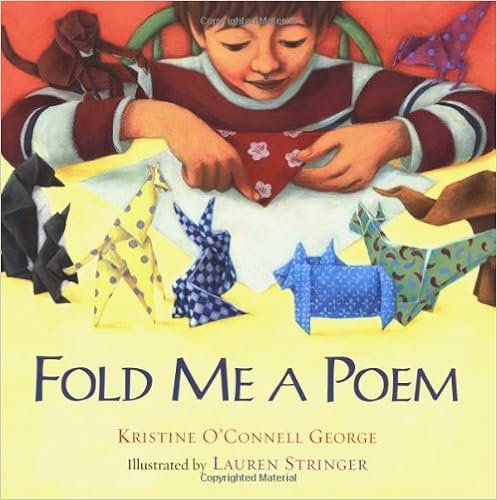
Poems about the origami creatures a little boy makes in the book and what he does with them after he makes them.
APA Reference of Book:

George, K. O., & Stringer, L. (2005). Fold me a poem. Orlando: Harcourt.

Impressions:
Very simple poems about the origami creatures the boy makes. The pictures are pretty and bright using different perspectives on different pages. Despite being simple text the poems are great and spark the imagination. It feels like the little boy is talking to the origami animals or the reader. I wish that it had how to make the origami animals in the book at the back! It does give you some suggestions for what books to read to learn more.

Professional Review:
K-Gr 2-- George's 32 brief poems focus on a boy as he folds a series of origami animals and imagines their thoughts and possible activities. Some of the selections exhibit a creative spark, while others tend to take their meaning from the illustrations, which are the real strength of the presentation. The vividly colored acrylics depict the boy actively engaged in play with his creations, and the details that Stringer provides infuse the verses with both energy and humor. Her illustrator's note offers insight into her own efforts to master the art of origami. No patterns or instructions are included, although a useful bibliography is appended to guide those wishing to learn the craft themselves.
~~~~~~~~
By Grace Oliff, Ann Blanche Smith School, Hillsdale, NJ
Oliff, G., Jones, T. E., Toth, L., Charnizon, M., Grabarek, D., & Raben, D. (2005). Fold Me a Poem. School Library Journal, 51(3), 193

Library Uses:
You could include this as a read aloud for different poems. Also as an extension you can have students try and fold basic animals.

My Rating: ***

April 16, 2017

March Book Madness Update

I have been so busy I forgot to post who won the March Book Madness!! Well I predicted it would be something else but I got knocked out in my bracket so I then chose Gaston and Ivan to pair off and that is what happened!! And the winner is.....................................................


                                 Gaston by [DiPucchio, Kelly]         

Oh and there is a sequel or spin off to this cute and funny book!!!!


Antoinette (Gaston and Friends) by [DiPucchio, Kelly]

April 15, 2017

Module 11 Informational Books

Book Cover:
Eat Like a Bear by [Sayre, April Pulley]
Book Summary:
The author takes you through the life of a bear from Spring until Winter talking about the things the bear does and what it eats in short sentences and questions.

APA Reference of Book:

Sayre, A. P., & Jenkins, S. (2013). Eat like a bear. New York: Ed. Henry Holt and Company.

Impressions:
I love the torn paper collages that show the bear as the seasons pass. They are very realistic and add depth to the pictures. There is a lot of repetitive text to help younger readers follow as well as some upper grade vocabulary such as  gnaw, parsnip, and bison. While the non-fiction narrative is about a bear there really isn't a lot of facts in the story itself. At the end there is a two page fact sheet telling you all about grizzly bears. Overall I liked the book not for learning more about bears but as an enjoyable book for fun.

Professional Review:

PreS-Gr 3— Posing the question, "Can you eat like a bear?" this book follows a brown bear as it forages for food throughout the year. Emerging from hibernation in April, the animal sets out on its quest. Each month provides a different delicacy: crispy roots and a ground squirrel in July, juicy huckleberries in September, a stash of pinecones in October. All serve to fatten up the omnivorous creature as it prepares once again for hibernation. The short text is set in a clear, large font and that, coupled with the big, full-color, cut-and torn-paper collage illustrations, makes it a natural for sharing with a group. The mammals themselves are rendered by using handmade Mexican bark paper. Its rough nature gives them greater impact and dimension on the pages. The extensive end notes provide details about the diet of the brown bear, or _I_Ursus artos_i_, its threatened status, and current scientific studies. This additional information increases the usefulness of the title, making it a viable classroom and research tool. That, along with the beautiful art, makes this a first choice for most libraries

Sites, S. L. (2013). Eat Like a Bear. School Library Journal, 59(10), 1.

Library Uses:  
For the younger grades you could use this to sequence months of the year as well as trying the art process of torn paper collages to make animals or other pictures. You could also focus on the illustrators of torn paper collages and do the art activity.

My Rating: ***

April 02, 2017

Module 10 Historical Fiction


Book Cover

Book Summary:
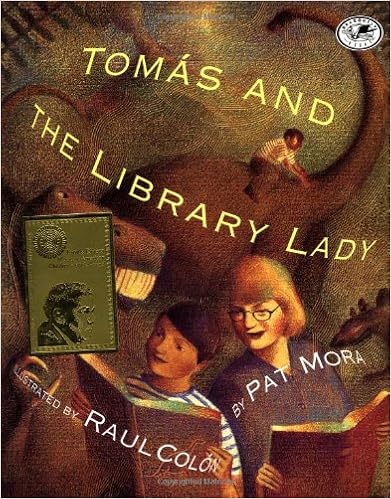
Tomas' family moves from Iowa to Texas to work in the fields. This story tells about how he went to the library and read books given to him by the librarian to read. He would get lost in the books and be able to take some home to read to his family because the librarian checked some out under her name. When it was time to leave he thanked her with some pan dulce and she gave him a new book and a love of reading to remember her by. Later on in life Tomas became a national education leader and professor but still remembered this librarian in Iowa.

APA Reference of Book:

Mora, P., & Colón, R. (1997). Tomas and the library lady. New York: A.A. Knopf.

Impressions:
WOW! This book was powerful in that it shows how just reading a book can transform your life. The librarian went out of her way to make the books accessible to Tomas by checking books out to him under her name and by giving him books that he was interested in. I also like how it shows the spanish/hispanic culture of story telling, food, and family. The pictures with their wood block printing also gave it a "old time" feel but also lent to the culture as well. Living in Texas this should be a staple in any classroom or library!

Professional Review:
Gr 2-4--Tomas Rivera, who at his death in 1984 was the Chancellor of the University of California at Riverside, grew up in a migrant family. Here, Mora tells the fictionalized story of one summer in his childhood during which his love of books and reading is fostered by a librarian in Iowa, who takes him under her wing while his family works the harvest. She introduces him to stories about dinosaurs, horses, and American Indians and allows him to take books home where he shares them with his parents, grandfather, and brother. When it is time for the family to return to Texas, she gives Tomas the greatest gift of all--a book of his own to keep. Colon's earthy sun-warmed colors, textured with swirling lines, add life to this biographical fragment and help portray Tomas's reading adventures in appealing ways. Stack this up with Sarah Stewart and David Small's The Library (Farrar, 1995) and Suzanne Williams and Steven Kellogg's Library Lil (Dial, 1997) to demonstrate the impact librarians can have on youngsters.

Elleman, B. (1997). Preschool to grade 4: Fiction. School Library Journal, 43(10), 105.

Library Uses:
Hmm. Not sure maybe to talk about someone who was important to their reading journey or just talk about what they remember about learning to read and books to now? Maybe favorite book? Or did someone ever recommend a book to you since the librarian gave him a book she thought he would like.

My Rating: I would give this book 4 out of 5 stars!

March 25, 2017

Module 9 Mystery


Book Cover

Book Summary:
In the land of nursery rhymes Little Boy Blue becomes a detective. One of his jobs is to find Little Miss Muffet. So he searches all over town meeting different nursery rhymes until he finds Miss Muffit who doesn't like curds and whey but wants to try porridge.....in the woods!

APA Reference of Book:

Metzger, S., & Arnold, T. (2011). Detective Blue [several different titles found for this book but used this since found on copyright page listed like this]. New York: Orchard Books.

Impressions:

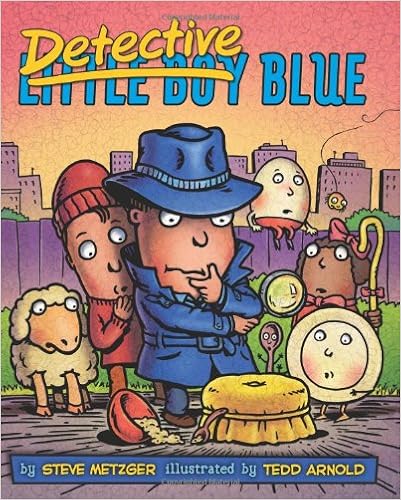
This was a cute easy mystery for young readers who like Fly Guy (same illustrator). The bulgy eyes and bean shaped people are funny looking like in Fly Guy but still not too over the top. It is set up like a graphic novel or comic which is also a format kids love, but they don't tend to read mysteries. I think the graphic novel format will draw them in to reading a mystery. It gives you the basics to a mystery: someone missing or has something missing,  clues, and the solution. Since this story is so simple I would recommend it for kinder through third grade. I also liked the additional I spy aspect in the front to try and find all the different nursery rhymes in the book.

Professional Review:

PreS-Gr 2-- Nursery-rhyme characters take on new, but somewhat familiar, roles in this comic-book-style mystery featuring the dedicated flatfoot formerly known as Little Boy Blue. After a typical day starting with cleaning the dish and spoon and making sure Mary's lamb doesn't get into school, Detective Blue is approached by a panicked Jack Sprat reporting that Miss Muffet is missing. In panels full of funny details and spoken asides, the gumshoe interviews various denizens of the rhyme scene to track down his quarry. The mystery is solved when a spider reports that Miss Muffet hates curds and whey and went looking for some tasty porridge. Blue finds Miss Goldilocks Muffet fleeing the three bears' cottage, resulting in a celebratory and satisfying conclusion. Referencing more than 20 nursery rhymes, the madcap mystery will keep children--and adults--intrigued with tiny tips that point the detective and readers in the right direction. The bright, full-color art was created using pencil sketches and Photoshop. Arnold's typical scribbly and big-eyed characters are a perfect match for the "film joie de vivre" atmosphere (the book is rightly dedicated to Stan Freberg) and even older kids will be unable to resist revisiting favorite rhymes from their childhood. A good bet for most collections.
 
Loch-Wouters, M. (2011). Detective Blue. School Library Journal, 57(7), 72.

Library Uses:

I would definitely use this to start a genre introduction to mysteries. I would talk about what a mystery is and the parts that make it a mystery with small posters or graphic posted on board/chart while reading the book. After the book discuss the different parts of what makes a mystery and identify or match it to the story. You could also do a sequencing activity with having them arrange the different pictures or parts of the story.

My Rating:
My students loved this book and another by a different author called Who Pushed Humpty Dumpty? and other Notorius Nurse Tale Mysteries by David Levinthal. Both are good small introductions to mysteries without a lot of words or chapters. I liked it too despite it being so simple.

February 26, 2017

Module 6: Picture Books

Book Cover:


Book Summary:
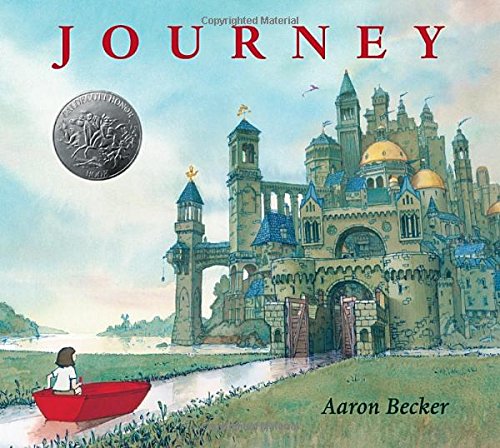
This book is told through pictures of a girl who finds a red item (crayon? marker?) and draws things in the picture to make something happen which makes something else happen until finally at the end she helps a bird escape a cage who ends up helping her.

APA Reference of Book:

Becker, A (2014). Journey. London: Walker Books.


Impressions: 
This reminded me a lot of Flotsam or Tuesday by Weisner and Harold and the Purple Crayon combined together.  While the pictures are good I didn't like them as much as Weisner's art. The pictures were not as clear or crisp which is probably deliberate because it looks a lot like a dream. I like the idea of the girl using the red drawing to advance the story and it worked for the most part.

Professional Review:

School Library Journal July 2013
Gr 1-4-In this auspicious debut picture book, a lonely girl escapes the boredom of a sepia-toned world by drawing a doorway to a magical realm. Harkening back to Crockett Johnson's Harold, this child uses a red crayon and a lot of imagination to venture across a Venice-like kingdom, fly among a fleet of steampunk airships, and take off on a magic carpet ride. When an act of compassion and bravery lands the heroine in a cage, it's her magic crayon and a bit of help from a new friend that save the day. This captivating wordless story has all the elements of a classic adventure: unknown lands, death-defying stunts, and a plucky lead. Finely detailed pen-and-ink line drawings combine with luminous washes of watercolor to create a rich and enchanting setting. Becker builds a sense of suspense by varying colorful full-page spreads with smaller vignettes that feature the girl and her red crayon surrounded by ample white space. The final page shows the youngster and her new friend riding a tandem bicycle pointing onward. Endpapers spotlight all manner of transportation: ships, trains, cars, and even space shuttles. The strong visual narrative makes this an appealing choice for a wide range of ages. By the turn of the last page, children will immediately begin imagining the next adventure.–Kiera Parrott, Darien Library, CT

Library Uses:
I would use this for writing a story or story telling. You could also have the students draw a picture and add their own own red drawn item and girl.  

My Rating: ***