Showing posts with label graphic novel. Show all posts

April 24, 2017

Module 13 Graphic Novels and Series Books

Book Cover:


Book Summary:
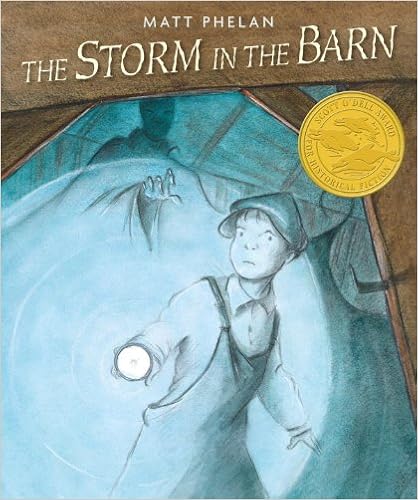
During the Great Depression Jack and his family are having problems. Jack's sister is sick, he is getting picked on, his dad is upset with him, and there has not been any rain. Jack does battle with a rain monster in the barn (did it really happen or is it dust dementia?) and finally it rains.

APA Reference of Book:

Phelan, M. (2011). The storm in the barn. Somerville, Mass: Candlewick.

Impressions:
The washed out watercolors of brown, black, grey, orange, and very rarely red help you envision that you are in the past. There is very little text which also gets across the sparseness of the times. Despite that you can follow what is going on. The battle between good and evil is a little dark so I wouldn't recommend this for younger readers. I really liked how this really captured the despaire and feelings of this time in history.

Professional Review:
Gr 5-7--It is 1937 in Kansas, during the Dust Bowl, and 11-year-old Jack can barely remember a world with plentiful water and crops. Unable to help his father with a harvest that isn't there, and bullied by the other boys his age, he feels like a useless baby. Stories offer a refuge, and there are multiple stories in this work. Jack's mother tells about the time when the land was a fertile "paradise." Jack's invalid sister, Dorothy, is readingThe Wizard of Oz, gaining inspiration from the adventures of another Kansan of the same name. Jack's friend comforts him with folktales about a brave man named Jack who masters nature, battling the King of the West Wind, the King of Blizzards, and the King of the Northeast Winds. In the end, Phelan turns the Dust Bowl into another one of Ernie's "Jack" tales when the real Jack encounters the Storm King in an abandoned barn and finds out that he has been holding back the rain. The boy must then gather the strength to determine his own narrative, as well as his parched town's future. Children can read this as a work of historical fiction, a piece of folklore, a scary story, a graphic novel, or all four. Written with simple, direct language, it's an almost wordless book: the illustrations' shadowy grays and blurry lines eloquently depict the haze of the dust. A complex but accessible and fascinating book.
~~~~~~~~

By Lisa Goldstein, Brooklyn Public Library, NY
Goldstein, L. (2009). The Storm in the Barn. School Library Journal, 55(9), 190.

Library Uses:

My Rating:

March 25, 2017

Module 9 Mystery


Book Cover

Book Summary:
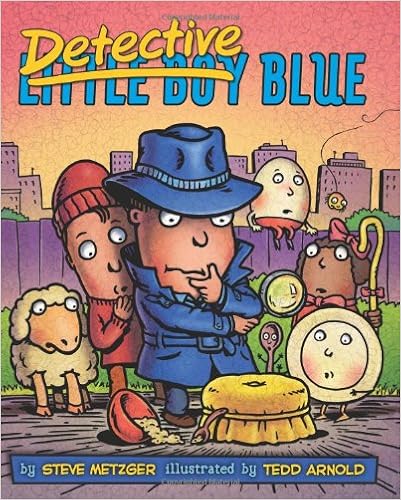
In the land of nursery rhymes Little Boy Blue becomes a detective. One of his jobs is to find Little Miss Muffet. So he searches all over town meeting different nursery rhymes until he finds Miss Muffit who doesn't like curds and whey but wants to try porridge.....in the woods!

APA Reference of Book:

Metzger, S., & Arnold, T. (2011). Detective Blue [several different titles found for this book but used this since found on copyright page listed like this]. New York: Orchard Books.

Impressions:

This was a cute easy mystery for young readers who like Fly Guy (same illustrator). The bulgy eyes and bean shaped people are funny looking like in Fly Guy but still not too over the top. It is set up like a graphic novel or comic which is also a format kids love, but they don't tend to read mysteries. I think the graphic novel format will draw them in to reading a mystery. It gives you the basics to a mystery: someone missing or has something missing,  clues, and the solution. Since this story is so simple I would recommend it for kinder through third grade. I also liked the additional I spy aspect in the front to try and find all the different nursery rhymes in the book.

Professional Review:

PreS-Gr 2-- Nursery-rhyme characters take on new, but somewhat familiar, roles in this comic-book-style mystery featuring the dedicated flatfoot formerly known as Little Boy Blue. After a typical day starting with cleaning the dish and spoon and making sure Mary's lamb doesn't get into school, Detective Blue is approached by a panicked Jack Sprat reporting that Miss Muffet is missing. In panels full of funny details and spoken asides, the gumshoe interviews various denizens of the rhyme scene to track down his quarry. The mystery is solved when a spider reports that Miss Muffet hates curds and whey and went looking for some tasty porridge. Blue finds Miss Goldilocks Muffet fleeing the three bears' cottage, resulting in a celebratory and satisfying conclusion. Referencing more than 20 nursery rhymes, the madcap mystery will keep children--and adults--intrigued with tiny tips that point the detective and readers in the right direction. The bright, full-color art was created using pencil sketches and Photoshop. Arnold's typical scribbly and big-eyed characters are a perfect match for the "film joie de vivre" atmosphere (the book is rightly dedicated to Stan Freberg) and even older kids will be unable to resist revisiting favorite rhymes from their childhood. A good bet for most collections.
Loch-Wouters, M. (2011). Detective Blue. School Library Journal, 57(7), 72.

Library Uses:

I would definitely use this to start a genre introduction to mysteries. I would talk about what a mystery is and the parts that make it a mystery with small posters or graphic posted on board/chart while reading the book. After the book discuss the different parts of what makes a mystery and identify or match it to the story. You could also do a sequencing activity with having them arrange the different pictures or parts of the story.

My Rating:
My students loved this book and another by a different author called Who Pushed Humpty Dumpty? and other Notorius Nurse Tale Mysteries by David Levinthal. Both are good small introductions to mysteries without a lot of words or chapters. I liked it too despite it being so simple.

January 12, 2011

Babymouse: Puppy Love

Babymouse: Puppy Love (Babymouse)Babymouse: Puppy Love by Jennifer L. Holm
My rating: 5 of 5 stars

I was searching the school library for graphic novels and saw this among the ones left. I have really wanted to get my hands on one of these to see if my students in 2nd grade would like them and whether it would be appropriate content. Well I read it while the students checked out books and the kids gathered around while I read it and laughed out loud several times. So there was definite interest even by the boys.

The pictures are cute in white and pink and the words for the most part I think are appropriate for 2nd grade and above. Some of the features like Baby Mouse talking to the narrator and some inferences may be beyond early 2nd graders I think mid year 2nd graders should have no problems.

My favorite chuckle was the animals hiding under the bed too funny! I also liked the talking back and forth between the narrator and Baby Mouse which is not a common thing in the graphic novels I have read so far. Pretty unique and a good example of adding voice to writing.

Overall I will definitely look into purchasing at least the Puppy Love volume of Babymouse and look into the other volumes as well!

December 05, 2010

Chicagoland Detective Agency: The Drained Brain Caper


The Drained Brains Caper (Chicagoland Detective Agency)The Drained Brains Caper by Trina Robbins
My rating: 4 of 5 stars

Interest group: Boys or girls
target audience: grade 5+, although younger grades should be able to read it

This graphic novel is a take off of the Stepford Wives story but geared for kids but with a twist! The graphics were great and the story was really funny! Megan reminded me of the girl from Beetlejuice but younger. The premise of the story is not new and the characters are not all that new either but they are really funny! Sometimes I didn't understand what was being said and I had to think about it (may be an adult thing) like why the boxes at the top of some pictures that told a book title? Well I figured out it was her point of view in a book title but some kids may not get that. Also I think it was pig latin that was used in one spot that stumped me and it took me a few minutes to figure it out (didn't use pig latin growing up).

One thing that may bother some parents/kids is that they mention doing experiments on the students and a dog. This may offend some people because it does show the dog all beat up. It didn't bother me but just wanted to mention it.

A great beginning to a new series. I would have definitely bought this for my Third grade class when I taught Third grade. I am debating whether to purchase for my Second Graders though. I will probably see if I can get a copy through the library to see if they like it before I will buy it.


Midway Monkey Madness


Midway Monkey Madness (DC Super-Pets)Midway Monkey Madness by Sarah Hines Stephens
My rating: 4 of 5 stars

In the recent years graphic novels have really made a come back and I have done lots of research on how using graphic novels can help get those reluctant readers to read (particularly the boys). So I am always on the look out for easy to read graphic novels to use in my Second Grade Classroom. This is not what I would consider a true graphic novel or comic but a cross over which is text with graphic novel/comic elements.

best for: First and Second Graders that can read pretty fluently. Third Graders and above may think the story too easy.

Interest group: While the main characters are male (except one of the twins Jayna) I think that girls will like this too.

What I liked:
-The story is pretty easy to follow (problem and solution) and the words for the most part are easy to read.

- The story has some good points like working together to solve a problem and to not give up if things don't work out right away.

-The text uses big bold words for sounds like in the old Batman cartoons and I think the kids will really like that.

-The cast of characters in the front is great for the young readers who need more structure.

-I also liked the glossary and the little section of jokes. The illustrations are bright and colorful and the facial expressions on Beppo and Gleek are hilarious!


What I didn't like:

-I think in some places it is too basic. I would have liked a little more description (showing) rather than telling us what happened.


Overall I think my students would love this book and I will definitely check out the others in this series.