Showing posts with label fairytale retelling. Show all posts

March 25, 2017

Module 9 Mystery


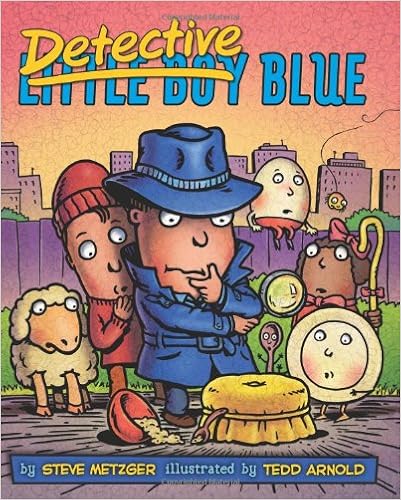
Book Cover

Book Summary:
In the land of nursery rhymes Little Boy Blue becomes a detective. One of his jobs is to find Little Miss Muffet. So he searches all over town meeting different nursery rhymes until he finds Miss Muffit who doesn't like curds and whey but wants to try porridge.....in the woods!

APA Reference of Book:

Metzger, S., & Arnold, T. (2011). Detective Blue [several different titles found for this book but used this since found on copyright page listed like this]. New York: Orchard Books.

Impressions:

This was a cute easy mystery for young readers who like Fly Guy (same illustrator). The bulgy eyes and bean shaped people are funny looking like in Fly Guy but still not too over the top. It is set up like a graphic novel or comic which is also a format kids love, but they don't tend to read mysteries. I think the graphic novel format will draw them in to reading a mystery. It gives you the basics to a mystery: someone missing or has something missing,  clues, and the solution. Since this story is so simple I would recommend it for kinder through third grade. I also liked the additional I spy aspect in the front to try and find all the different nursery rhymes in the book.

Professional Review:

PreS-Gr 2-- Nursery-rhyme characters take on new, but somewhat familiar, roles in this comic-book-style mystery featuring the dedicated flatfoot formerly known as Little Boy Blue. After a typical day starting with cleaning the dish and spoon and making sure Mary's lamb doesn't get into school, Detective Blue is approached by a panicked Jack Sprat reporting that Miss Muffet is missing. In panels full of funny details and spoken asides, the gumshoe interviews various denizens of the rhyme scene to track down his quarry. The mystery is solved when a spider reports that Miss Muffet hates curds and whey and went looking for some tasty porridge. Blue finds Miss Goldilocks Muffet fleeing the three bears' cottage, resulting in a celebratory and satisfying conclusion. Referencing more than 20 nursery rhymes, the madcap mystery will keep children--and adults--intrigued with tiny tips that point the detective and readers in the right direction. The bright, full-color art was created using pencil sketches and Photoshop. Arnold's typical scribbly and big-eyed characters are a perfect match for the "film joie de vivre" atmosphere (the book is rightly dedicated to Stan Freberg) and even older kids will be unable to resist revisiting favorite rhymes from their childhood. A good bet for most collections.
Loch-Wouters, M. (2011). Detective Blue. School Library Journal, 57(7), 72.

Library Uses:

I would definitely use this to start a genre introduction to mysteries. I would talk about what a mystery is and the parts that make it a mystery with small posters or graphic posted on board/chart while reading the book. After the book discuss the different parts of what makes a mystery and identify or match it to the story. You could also do a sequencing activity with having them arrange the different pictures or parts of the story.

My Rating:
My students loved this book and another by a different author called Who Pushed Humpty Dumpty? and other Notorius Nurse Tale Mysteries by David Levinthal. Both are good small introductions to mysteries without a lot of words or chapters. I liked it too despite it being so simple.

February 01, 2017

Module 1 Little Red Writing

Book Cover:

Little Red Writing


Book Summary: 
Little Red needs to write a story and she traveled around the school looking for ways to make her writing better. Some of the places she went included the gym for adding excitement, the library for descriptive words, and the supply closet to add longer sentences (without punctuation stops). Finally she gets to the Principal office where the Wolf 3000 pencil sharpener took Principal Granny's place. Little Red saved the Principal by blowing up the sharpener. She then wrote her own story based on what happened and read it to the class.

APA Reference of Book:
Holub, J., & Sweet, M. (2013). Little Red writing. San Francisco, CA: Chronicle Books.

Impressions:
The front pages included things from the story like a conversation between characters and a newspaper from the school Little Red is at. The paper includes the copyright information on it. I really like when books use front and end pages to help tell the story and this was cute. I liked the bright cheery colors and illustrations that looked a little bit like a comic or graphic novel. There were different types of text structures and styles all through the book to help differentiate between story and talking of characters. Vocabulary was excellent throughout the book with words such as boogied, hingered, squirrely, and many more instead of weak words. The plot showed how Little Red wanted to write a great story and her problems going about doing it but set in the story of Little Red Riding Hood. So any age group could identify with it. Due to the busy pictures and high vocabulary I would think this could be independently read in second grade to fifth grade.

Professional Review:
Balanced gracefully on her point, Little Red is a courageous young pencil with a storytelling assignment from school. While the other young pencils choose to write about "Pencilvania" or themes based on their novelty erasers, Little Red decides to compose a heroic story. "Remember, it's OK to wander a little, but stick to your basic story path so you don't get lost," warns her teacher, Ms. 2. Holub (Zero the Hero) cleverly combines two elementary-school formulas--the fairy tale and the writing exercise--as she shares the basics of storytelling and grammar. When Little Red activates her narrative with verbs, she "cartwheel[s] right off the page and into… a deep, dark, descriptive forest" where words like "verdant" and "bosky" decorate leaves. Sweet (River of Words) illustrates in a flurry of colored pencil, watercolor, and collage. On yellowed, heavily doodled composition notepaper, she playfully mingles calligraphy, classroom settings, and images of Red defeating a sharp-toothed foe, the Wolf 3000 pencil sharpener. With style, humor, and solid writing advice, Holub and Sweet point out the latent creative potential within any desk drawer or supply cabinet. Ages 5--8. Author's agent: Liza Pulitzer Voges, Eden Street Literary. (Oct.)

Little Red Writing. (2013). Publishers Weekly, 260(36), 56-57

Library Uses:
There can be many uses for this story! You can focus on the one or several of the writing aspect in the story such as plot, word choice, or punctuation. I would focus on comparing fractured fairy tales. I would read this with another Little Red Riding hood story such as Ninja Red Riding Hood, Lon Popo, or Little Red Cowboy Hat and make a chart for main character, problem, solution, setting, and anything else the students notice. This could also be a springboard for the upper grades to write their own retelling.

My Rating: ****