Showing posts with label grade 1-2. Show all posts

April 15, 2017

Module 11 Informational Books

Book Cover:
Eat Like a Bear by [Sayre, April Pulley]
Book Summary:
The author takes you through the life of a bear from Spring until Winter talking about the things the bear does and what it eats in short sentences and questions.

APA Reference of Book:

Sayre, A. P., & Jenkins, S. (2013). Eat like a bear. New York: Ed. Henry Holt and Company.

Impressions:
I love the torn paper collages that show the bear as the seasons pass. They are very realistic and add depth to the pictures. There is a lot of repetitive text to help younger readers follow as well as some upper grade vocabulary such as  gnaw, parsnip, and bison. While the non-fiction narrative is about a bear there really isn't a lot of facts in the story itself. At the end there is a two page fact sheet telling you all about grizzly bears. Overall I liked the book not for learning more about bears but as an enjoyable book for fun.

Professional Review:

PreS-Gr 3— Posing the question, "Can you eat like a bear?" this book follows a brown bear as it forages for food throughout the year. Emerging from hibernation in April, the animal sets out on its quest. Each month provides a different delicacy: crispy roots and a ground squirrel in July, juicy huckleberries in September, a stash of pinecones in October. All serve to fatten up the omnivorous creature as it prepares once again for hibernation. The short text is set in a clear, large font and that, coupled with the big, full-color, cut-and torn-paper collage illustrations, makes it a natural for sharing with a group. The mammals themselves are rendered by using handmade Mexican bark paper. Its rough nature gives them greater impact and dimension on the pages. The extensive end notes provide details about the diet of the brown bear, or _I_Ursus artos_i_, its threatened status, and current scientific studies. This additional information increases the usefulness of the title, making it a viable classroom and research tool. That, along with the beautiful art, makes this a first choice for most libraries

Sites, S. L. (2013). Eat Like a Bear. School Library Journal, 59(10), 1.

Library Uses:  
For the younger grades you could use this to sequence months of the year as well as trying the art process of torn paper collages to make animals or other pictures. You could also focus on the illustrators of torn paper collages and do the art activity.

My Rating: ***
April 02, 2017

Module 10 Historical Fiction


Book Cover

Book Summary:
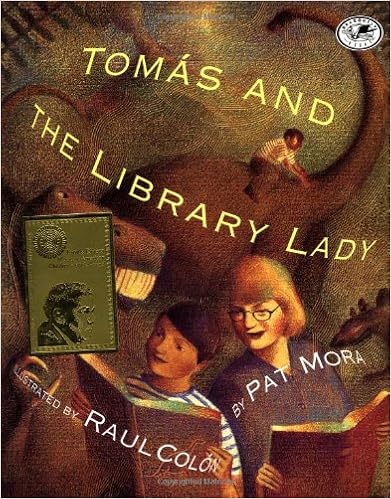
Tomas' family moves from Iowa to Texas to work in the fields. This story tells about how he went to the library and read books given to him by the librarian to read. He would get lost in the books and be able to take some home to read to his family because the librarian checked some out under her name. When it was time to leave he thanked her with some pan dulce and she gave him a new book and a love of reading to remember her by. Later on in life Tomas became a national education leader and professor but still remembered this librarian in Iowa.

APA Reference of Book:

Mora, P., & Colón, R. (1997). Tomas and the library lady. New York: A.A. Knopf.

Impressions:
WOW! This book was powerful in that it shows how just reading a book can transform your life. The librarian went out of her way to make the books accessible to Tomas by checking books out to him under her name and by giving him books that he was interested in. I also like how it shows the spanish/hispanic culture of story telling, food, and family. The pictures with their wood block printing also gave it a "old time" feel but also lent to the culture as well. Living in Texas this should be a staple in any classroom or library!

Professional Review:
Gr 2-4--Tomas Rivera, who at his death in 1984 was the Chancellor of the University of California at Riverside, grew up in a migrant family. Here, Mora tells the fictionalized story of one summer in his childhood during which his love of books and reading is fostered by a librarian in Iowa, who takes him under her wing while his family works the harvest. She introduces him to stories about dinosaurs, horses, and American Indians and allows him to take books home where he shares them with his parents, grandfather, and brother. When it is time for the family to return to Texas, she gives Tomas the greatest gift of all--a book of his own to keep. Colon's earthy sun-warmed colors, textured with swirling lines, add life to this biographical fragment and help portray Tomas's reading adventures in appealing ways. Stack this up with Sarah Stewart and David Small's The Library (Farrar, 1995) and Suzanne Williams and Steven Kellogg's Library Lil (Dial, 1997) to demonstrate the impact librarians can have on youngsters.

Elleman, B. (1997). Preschool to grade 4: Fiction. School Library Journal, 43(10), 105.

Library Uses:
Hmm. Not sure maybe to talk about someone who was important to their reading journey or just talk about what they remember about learning to read and books to now? Maybe favorite book? Or did someone ever recommend a book to you since the librarian gave him a book she thought he would like.

My Rating: I would give this book 4 out of 5 stars!

March 25, 2017

Module 9 Mystery


Book Cover

Book Summary:
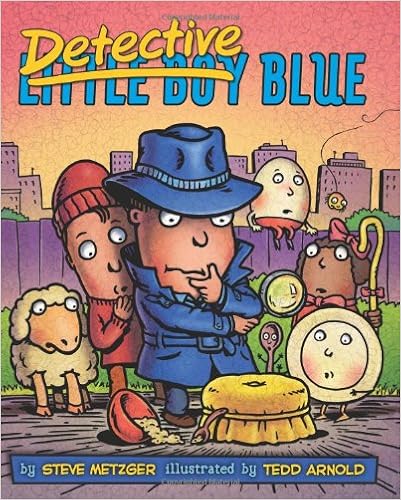
In the land of nursery rhymes Little Boy Blue becomes a detective. One of his jobs is to find Little Miss Muffet. So he searches all over town meeting different nursery rhymes until he finds Miss Muffit who doesn't like curds and whey but wants to try porridge.....in the woods!

APA Reference of Book:

Metzger, S., & Arnold, T. (2011). Detective Blue [several different titles found for this book but used this since found on copyright page listed like this]. New York: Orchard Books.

Impressions:

This was a cute easy mystery for young readers who like Fly Guy (same illustrator). The bulgy eyes and bean shaped people are funny looking like in Fly Guy but still not too over the top. It is set up like a graphic novel or comic which is also a format kids love, but they don't tend to read mysteries. I think the graphic novel format will draw them in to reading a mystery. It gives you the basics to a mystery: someone missing or has something missing,  clues, and the solution. Since this story is so simple I would recommend it for kinder through third grade. I also liked the additional I spy aspect in the front to try and find all the different nursery rhymes in the book.

Professional Review:

PreS-Gr 2-- Nursery-rhyme characters take on new, but somewhat familiar, roles in this comic-book-style mystery featuring the dedicated flatfoot formerly known as Little Boy Blue. After a typical day starting with cleaning the dish and spoon and making sure Mary's lamb doesn't get into school, Detective Blue is approached by a panicked Jack Sprat reporting that Miss Muffet is missing. In panels full of funny details and spoken asides, the gumshoe interviews various denizens of the rhyme scene to track down his quarry. The mystery is solved when a spider reports that Miss Muffet hates curds and whey and went looking for some tasty porridge. Blue finds Miss Goldilocks Muffet fleeing the three bears' cottage, resulting in a celebratory and satisfying conclusion. Referencing more than 20 nursery rhymes, the madcap mystery will keep children--and adults--intrigued with tiny tips that point the detective and readers in the right direction. The bright, full-color art was created using pencil sketches and Photoshop. Arnold's typical scribbly and big-eyed characters are a perfect match for the "film joie de vivre" atmosphere (the book is rightly dedicated to Stan Freberg) and even older kids will be unable to resist revisiting favorite rhymes from their childhood. A good bet for most collections.
Loch-Wouters, M. (2011). Detective Blue. School Library Journal, 57(7), 72.

Library Uses:

I would definitely use this to start a genre introduction to mysteries. I would talk about what a mystery is and the parts that make it a mystery with small posters or graphic posted on board/chart while reading the book. After the book discuss the different parts of what makes a mystery and identify or match it to the story. You could also do a sequencing activity with having them arrange the different pictures or parts of the story.

My Rating:
My students loved this book and another by a different author called Who Pushed Humpty Dumpty? and other Notorius Nurse Tale Mysteries by David Levinthal. Both are good small introductions to mysteries without a lot of words or chapters. I liked it too despite it being so simple.

March 04, 2017

Module 4 Newbery Award

Book Cover:


Last Stop on Market Street by [de la Peña, Matt]


Book Summary:

A boy and his mom get on a bus to go to a soup kitchen on Sunday. As they ride the bus the boy listens to music that the people on the bus make.

APA Reference of Book:

Peña, M. D., & Robinson, C. (2015). Last stop on Market Street. New York, NY: G.P. Putnam's Sons Books for Young Readers.

Impressions:

The pictures are very simple and use primary colors to show the bus as it takes the boy and his mom to Market Street. I found the story cute with simple sentences and you don't know until the end why they are taking the bus. As you get to the soup kitchen you realize that the boy and his mom volunteer their time. I liked that this showed how ordinary people can help others in small ways.

Professional Review:

CJ and his nana depart church and make it to the bus stop just in time to avoid an oncoming rain shower. They board the bus, and while CJ is full of questions and complaints (why don't they have a car? why must they make this trip every week? and so forth), Nana's resolute responses articulate the glories of their rich, vibrant life in the city, as presented by the bus' passengers and passages. A tattooed man checks his cell phone. An older woman keeps butterflies in a jar. A musician tunes and plays his guitar. At last the pair arrive at the titular destination and proceed to the soup kitchen where, upon recognizing friendly faces, CJ is glad they came to help. Robinson's bright, simple, multicultural figures, with their rounded heads, boxy bodies, and friendly expressions, contrast nicely with de la Peñas lyrical language, establishing a unique tone that reflects both CJ's wonder and his nanas wisdom. The celebratory warmth is irresistible, offering a picture of community that resonates with harmony and diversity. -Thom Barthelmess

Barthelmess, T. (2015). Last stop on market street. The Booklist, 111(11), 46. Retrieved from https://libproxy.library.unt.edu/login?url=http://search.proquest.com/docview/1651244372?accountid=7113

Library Uses:
Like CJ does in the book have the students listen to music with their eyes closed. Then listen again and have them draw or color a picture while the music plays. Discuss how the music helped you draw.

My Rating: ***


February 26, 2017

Module 6: Picture Books

Book Cover:


Book Summary:
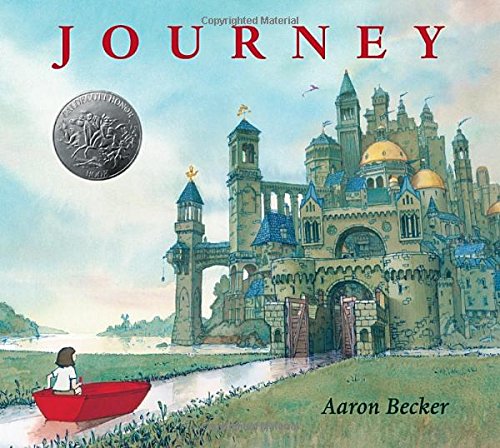
This book is told through pictures of a girl who finds a red item (crayon? marker?) and draws things in the picture to make something happen which makes something else happen until finally at the end she helps a bird escape a cage who ends up helping her.

APA Reference of Book:

Becker, A (2014). Journey. London: Walker Books.


Impressions: 
This reminded me a lot of Flotsam or Tuesday by Weisner and Harold and the Purple Crayon combined together.  While the pictures are good I didn't like them as much as Weisner's art. The pictures were not as clear or crisp which is probably deliberate because it looks a lot like a dream. I like the idea of the girl using the red drawing to advance the story and it worked for the most part.

Professional Review:

School Library Journal July 2013
Gr 1-4-In this auspicious debut picture book, a lonely girl escapes the boredom of a sepia-toned world by drawing a doorway to a magical realm. Harkening back to Crockett Johnson's Harold, this child uses a red crayon and a lot of imagination to venture across a Venice-like kingdom, fly among a fleet of steampunk airships, and take off on a magic carpet ride. When an act of compassion and bravery lands the heroine in a cage, it's her magic crayon and a bit of help from a new friend that save the day. This captivating wordless story has all the elements of a classic adventure: unknown lands, death-defying stunts, and a plucky lead. Finely detailed pen-and-ink line drawings combine with luminous washes of watercolor to create a rich and enchanting setting. Becker builds a sense of suspense by varying colorful full-page spreads with smaller vignettes that feature the girl and her red crayon surrounded by ample white space. The final page shows the youngster and her new friend riding a tandem bicycle pointing onward. Endpapers spotlight all manner of transportation: ships, trains, cars, and even space shuttles. The strong visual narrative makes this an appealing choice for a wide range of ages. By the turn of the last page, children will immediately begin imagining the next adventure.–Kiera Parrott, Darien Library, CT

Library Uses:
I would use this for writing a story or story telling. You could also have the students draw a picture and add their own own red drawn item and girl.  

My Rating: ***

February 01, 2017

Module 2 The Snowy Day

The Snowy Day

Book Cover:

Book Summary:

APA Reference of Book:
Keats, E. J. (1962). The snowy day. New York: Viking Press.

Impressions:

Professional Review:
In this mood book, never static but sparkling with atmosphere in lovely water-color pictures, a small boy experiences the joys of a snowy day. The brief, vividly expressed text points out his new awareness of the sight and texture of snow (the crunch, crunch of his feet making tracks), the sound (the plop of snow smacked off a tree with a stick), and the fun of playing with snow — then his thinking and thinking about the outdoor adventures later in warm bathtub and bed, while more snowflakes fall. Perfect for a snowy day’s preschool story hour.

Haviland, V. (1963, February). The Snowy Day. The Hornbook Magazine. Retrieved February 1, 2017, from http://www.hbook.com/1963/02/choosing-books/reviews/review-of-the-snowy-day/#_

Library Uses:


My Rating:

Module 1 Little Red Writing

Book Cover:

Little Red Writing


Book Summary: 
Little Red needs to write a story and she traveled around the school looking for ways to make her writing better. Some of the places she went included the gym for adding excitement, the library for descriptive words, and the supply closet to add longer sentences (without punctuation stops). Finally she gets to the Principal office where the Wolf 3000 pencil sharpener took Principal Granny's place. Little Red saved the Principal by blowing up the sharpener. She then wrote her own story based on what happened and read it to the class.

APA Reference of Book:
Holub, J., & Sweet, M. (2013). Little Red writing. San Francisco, CA: Chronicle Books.

Impressions:
The front pages included things from the story like a conversation between characters and a newspaper from the school Little Red is at. The paper includes the copyright information on it. I really like when books use front and end pages to help tell the story and this was cute. I liked the bright cheery colors and illustrations that looked a little bit like a comic or graphic novel. There were different types of text structures and styles all through the book to help differentiate between story and talking of characters. Vocabulary was excellent throughout the book with words such as boogied, hingered, squirrely, and many more instead of weak words. The plot showed how Little Red wanted to write a great story and her problems going about doing it but set in the story of Little Red Riding Hood. So any age group could identify with it. Due to the busy pictures and high vocabulary I would think this could be independently read in second grade to fifth grade.

Professional Review:
Balanced gracefully on her point, Little Red is a courageous young pencil with a storytelling assignment from school. While the other young pencils choose to write about "Pencilvania" or themes based on their novelty erasers, Little Red decides to compose a heroic story. "Remember, it's OK to wander a little, but stick to your basic story path so you don't get lost," warns her teacher, Ms. 2. Holub (Zero the Hero) cleverly combines two elementary-school formulas--the fairy tale and the writing exercise--as she shares the basics of storytelling and grammar. When Little Red activates her narrative with verbs, she "cartwheel[s] right off the page and into… a deep, dark, descriptive forest" where words like "verdant" and "bosky" decorate leaves. Sweet (River of Words) illustrates in a flurry of colored pencil, watercolor, and collage. On yellowed, heavily doodled composition notepaper, she playfully mingles calligraphy, classroom settings, and images of Red defeating a sharp-toothed foe, the Wolf 3000 pencil sharpener. With style, humor, and solid writing advice, Holub and Sweet point out the latent creative potential within any desk drawer or supply cabinet. Ages 5--8. Author's agent: Liza Pulitzer Voges, Eden Street Literary. (Oct.)

Little Red Writing. (2013). Publishers Weekly, 260(36), 56-57

Library Uses:
There can be many uses for this story! You can focus on the one or several of the writing aspect in the story such as plot, word choice, or punctuation. I would focus on comparing fractured fairy tales. I would read this with another Little Red Riding hood story such as Ninja Red Riding Hood, Lon Popo, or Little Red Cowboy Hat and make a chart for main character, problem, solution, setting, and anything else the students notice. This could also be a springboard for the upper grades to write their own retelling.

My Rating: ****


January 28, 2017

Module 1 Winston the Book Wolf

Book Cover:


APA Reference of Book:
McGee, M., & Beck, I. (2006). Winston the book wolf. New York: Walker.


Book Summary:
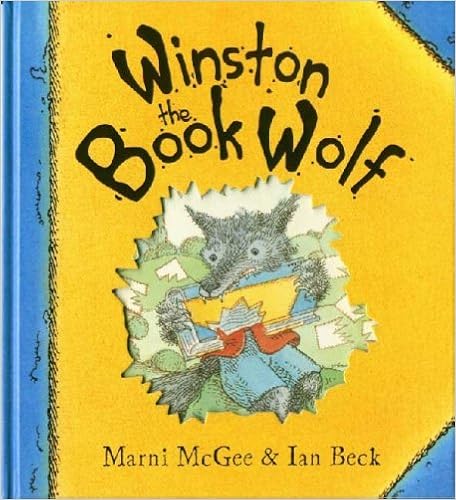
Winston likes to eat words and isn't allowed into the library because he destroys it. Rosie (little red riding hood) shows him how to read. Once he learns he disguises himself as Granny and gets inside without any problems. He becomes the story lady and reads to the children without destroying the books or library.


Impressions:
The story was cute and included different fairy tale characters sprinkled through out the book. Text was used in mini boxs that were "bitten" and some curved around the pages. However the same font was used throughout even the bold and separated interesting words. The pictures were cartoony with a grainy or block printing look about them. While I liked the idea that Winston loved to eat words and learns to read,  I didn't like that he wasn't allowed in the library and had to trick them to get in. So I am torn about whether I liked it enough to use it again. I do think that it redeems itself a little bit when it talks about reading the books rather than eating them. It does have a few good words for vocabulary.

Professional Review:

Some wolves like to eat little pigs; some have a penchant for grannies, but Winston can't get enough of words. Banned from the library for literally devouring books (the paper-over-board book's cover has a bite-size die-cut hole), he's taken under the wing of Rosie, who just happens to sport a red-hooded sweatshirt. She tutors him in a more socially acceptable and personally fulfilling approach to savoring words. ""Winston caught on fast. He learned to eat words with his eyes, which is to say: Winston learned to read!"" With that mission accomplished, Rosie and Winston next conspire to get him back into the library-and with the help of some of Grandma's clothes and a natural flair for drag, Winston soon draws record crowds as the Story Lady. ""If anyone noticed the sharp, white teeth, no one complained,"" McGee says with a wink. The text may be wordy, but Beck's (Tom and the Island of Dinosaurs) illustrations exude a breezy, contemporary feel, from his delicate ink lines and washes of cheery color t

Winston the Book Wolf. (2006, August, 7). Publishers Weekly [Book Review]. Retrieved from http://www.publishersweekly.com/978-0-8027-9569-4

Library Uses: 
For grades kinder through fifth grade readers I would have a display wall of words that are great words that Winston may have eaten that students have found in their books that they are reading. I would put out index cards and crayons or pencils for them to write the word on and their name. Then either they would post them or I would provide a box to put them in to have an adult or help put up.


My Rating:  ***

January 22, 2011

Hot Rod Hamster Review

Hot Rod Hamster!Hot Rod Hamster! by Cynthia Lord
My rating: 5 of 5 stars

I bought this at the book fair at the beginning of the year because of the cute and funny pictures as well as the language in particular the adjectives that the hamster uses. The kids loved it and I did too. They got to choose how the hot rod was built and we discussed as a class why they chose that one. A sure reread every year and to use in grammar lessons. This could also be used for writing about a hot rod that they drew or made at home.
 

January 12, 2011

Buster Goes to Cowboy Camp

Buster Goes to Cowboy CampBuster Goes to Cowboy Camp by Denise Fleming
My rating: 3 of 5 stars

I saw this sitting on top a shelf when checking out books at the library yesterday and just had to check it out since my theme is cowboys/western in my classroom. I really liked the glossary on the back of the book for cowboy terminology. I will have to read this at the beginning of the year to get us into the "theme" of our class.

I really liked the "mini" headings or chapters to get younger students ready for chapters. I loved the progression of missing "brown shoes" (owners) and not liking camp to liking camp at the end. There is also a lot to talk about as far as inferencing goes. Like who is brown shoes, pink slippers, who is in the picture of the wanted sign and why did he want that person/animal? Loved the bulldog named Snarkle (lol) he was funny and the kids liked him too.

I didn't really care for all of the pictures. For the most part they are good but there are several that were a little muddy and dark looking. The media used I think was okay but sometimes too dark a color. Also sometimes the wording is very basic and stilted. I think this is due to the age the book is geared to. Despite this I think it would be good for the beginning of the year.

December 05, 2010

Midway Monkey Madness


Midway Monkey Madness (DC Super-Pets)Midway Monkey Madness by Sarah Hines Stephens
My rating: 4 of 5 stars

In the recent years graphic novels have really made a come back and I have done lots of research on how using graphic novels can help get those reluctant readers to read (particularly the boys). So I am always on the look out for easy to read graphic novels to use in my Second Grade Classroom. This is not what I would consider a true graphic novel or comic but a cross over which is text with graphic novel/comic elements.

best for: First and Second Graders that can read pretty fluently. Third Graders and above may think the story too easy.

Interest group: While the main characters are male (except one of the twins Jayna) I think that girls will like this too.

What I liked:
-The story is pretty easy to follow (problem and solution) and the words for the most part are easy to read.

- The story has some good points like working together to solve a problem and to not give up if things don't work out right away.

-The text uses big bold words for sounds like in the old Batman cartoons and I think the kids will really like that.

-The cast of characters in the front is great for the young readers who need more structure.

-I also liked the glossary and the little section of jokes. The illustrations are bright and colorful and the facial expressions on Beppo and Gleek are hilarious!


What I didn't like:

-I think in some places it is too basic. I would have liked a little more description (showing) rather than telling us what happened.


Overall I think my students would love this book and I will definitely check out the others in this series.