April 16, 2017

March Book Madness Update

I have been so busy I forgot to post who won the March Book Madness!! Well I predicted it would be something else but I got knocked out in my bracket so I then chose Gaston and Ivan to pair off and that is what happened!! And the winner is.....................................................


                                 Gaston by [DiPucchio, Kelly]         

Oh and there is a sequel or spin off to this cute and funny book!!!!


Antoinette (Gaston and Friends) by [DiPucchio, Kelly]

April 15, 2017

Module 11 Informational Books

Book Cover:
Eat Like a Bear by [Sayre, April Pulley]
Book Summary:
The author takes you through the life of a bear from Spring until Winter talking about the things the bear does and what it eats in short sentences and questions.

APA Reference of Book:

Sayre, A. P., & Jenkins, S. (2013). Eat like a bear. New York: Ed. Henry Holt and Company.

Impressions:
I love the torn paper collages that show the bear as the seasons pass. They are very realistic and add depth to the pictures. There is a lot of repetitive text to help younger readers follow as well as some upper grade vocabulary such as  gnaw, parsnip, and bison. While the non-fiction narrative is about a bear there really isn't a lot of facts in the story itself. At the end there is a two page fact sheet telling you all about grizzly bears. Overall I liked the book not for learning more about bears but as an enjoyable book for fun.

Professional Review:

PreS-Gr 3— Posing the question, "Can you eat like a bear?" this book follows a brown bear as it forages for food throughout the year. Emerging from hibernation in April, the animal sets out on its quest. Each month provides a different delicacy: crispy roots and a ground squirrel in July, juicy huckleberries in September, a stash of pinecones in October. All serve to fatten up the omnivorous creature as it prepares once again for hibernation. The short text is set in a clear, large font and that, coupled with the big, full-color, cut-and torn-paper collage illustrations, makes it a natural for sharing with a group. The mammals themselves are rendered by using handmade Mexican bark paper. Its rough nature gives them greater impact and dimension on the pages. The extensive end notes provide details about the diet of the brown bear, or _I_Ursus artos_i_, its threatened status, and current scientific studies. This additional information increases the usefulness of the title, making it a viable classroom and research tool. That, along with the beautiful art, makes this a first choice for most libraries

Sites, S. L. (2013). Eat Like a Bear. School Library Journal, 59(10), 1.

Library Uses:  
For the younger grades you could use this to sequence months of the year as well as trying the art process of torn paper collages to make animals or other pictures. You could also focus on the illustrators of torn paper collages and do the art activity.

My Rating: ***

April 02, 2017

Module 10 Historical Fiction


Book Cover

Book Summary:
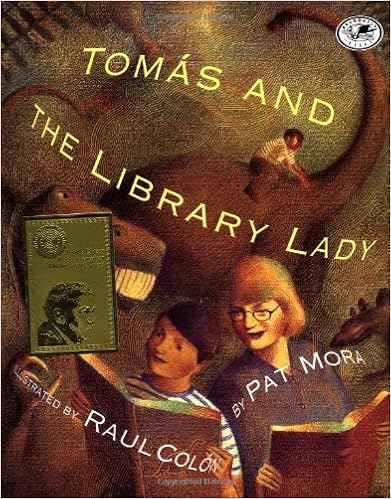
Tomas' family moves from Iowa to Texas to work in the fields. This story tells about how he went to the library and read books given to him by the librarian to read. He would get lost in the books and be able to take some home to read to his family because the librarian checked some out under her name. When it was time to leave he thanked her with some pan dulce and she gave him a new book and a love of reading to remember her by. Later on in life Tomas became a national education leader and professor but still remembered this librarian in Iowa.

APA Reference of Book:

Mora, P., & Colón, R. (1997). Tomas and the library lady. New York: A.A. Knopf.

Impressions:
WOW! This book was powerful in that it shows how just reading a book can transform your life. The librarian went out of her way to make the books accessible to Tomas by checking books out to him under her name and by giving him books that he was interested in. I also like how it shows the spanish/hispanic culture of story telling, food, and family. The pictures with their wood block printing also gave it a "old time" feel but also lent to the culture as well. Living in Texas this should be a staple in any classroom or library!

Professional Review:
Gr 2-4--Tomas Rivera, who at his death in 1984 was the Chancellor of the University of California at Riverside, grew up in a migrant family. Here, Mora tells the fictionalized story of one summer in his childhood during which his love of books and reading is fostered by a librarian in Iowa, who takes him under her wing while his family works the harvest. She introduces him to stories about dinosaurs, horses, and American Indians and allows him to take books home where he shares them with his parents, grandfather, and brother. When it is time for the family to return to Texas, she gives Tomas the greatest gift of all--a book of his own to keep. Colon's earthy sun-warmed colors, textured with swirling lines, add life to this biographical fragment and help portray Tomas's reading adventures in appealing ways. Stack this up with Sarah Stewart and David Small's The Library (Farrar, 1995) and Suzanne Williams and Steven Kellogg's Library Lil (Dial, 1997) to demonstrate the impact librarians can have on youngsters.

Elleman, B. (1997). Preschool to grade 4: Fiction. School Library Journal, 43(10), 105.

Library Uses:
Hmm. Not sure maybe to talk about someone who was important to their reading journey or just talk about what they remember about learning to read and books to now? Maybe favorite book? Or did someone ever recommend a book to you since the librarian gave him a book she thought he would like.

My Rating: I would give this book 4 out of 5 stars!

March 25, 2017

Module 9 Mystery


Book Cover

Book Summary:
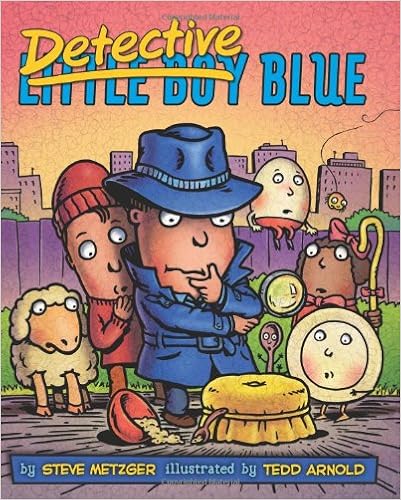
In the land of nursery rhymes Little Boy Blue becomes a detective. One of his jobs is to find Little Miss Muffet. So he searches all over town meeting different nursery rhymes until he finds Miss Muffit who doesn't like curds and whey but wants to try porridge.....in the woods!

APA Reference of Book:

Metzger, S., & Arnold, T. (2011). Detective Blue [several different titles found for this book but used this since found on copyright page listed like this]. New York: Orchard Books.

Impressions:

This was a cute easy mystery for young readers who like Fly Guy (same illustrator). The bulgy eyes and bean shaped people are funny looking like in Fly Guy but still not too over the top. It is set up like a graphic novel or comic which is also a format kids love, but they don't tend to read mysteries. I think the graphic novel format will draw them in to reading a mystery. It gives you the basics to a mystery: someone missing or has something missing,  clues, and the solution. Since this story is so simple I would recommend it for kinder through third grade. I also liked the additional I spy aspect in the front to try and find all the different nursery rhymes in the book.

Professional Review:

PreS-Gr 2-- Nursery-rhyme characters take on new, but somewhat familiar, roles in this comic-book-style mystery featuring the dedicated flatfoot formerly known as Little Boy Blue. After a typical day starting with cleaning the dish and spoon and making sure Mary's lamb doesn't get into school, Detective Blue is approached by a panicked Jack Sprat reporting that Miss Muffet is missing. In panels full of funny details and spoken asides, the gumshoe interviews various denizens of the rhyme scene to track down his quarry. The mystery is solved when a spider reports that Miss Muffet hates curds and whey and went looking for some tasty porridge. Blue finds Miss Goldilocks Muffet fleeing the three bears' cottage, resulting in a celebratory and satisfying conclusion. Referencing more than 20 nursery rhymes, the madcap mystery will keep children--and adults--intrigued with tiny tips that point the detective and readers in the right direction. The bright, full-color art was created using pencil sketches and Photoshop. Arnold's typical scribbly and big-eyed characters are a perfect match for the "film joie de vivre" atmosphere (the book is rightly dedicated to Stan Freberg) and even older kids will be unable to resist revisiting favorite rhymes from their childhood. A good bet for most collections.
 
Loch-Wouters, M. (2011). Detective Blue. School Library Journal, 57(7), 72.

Library Uses:

I would definitely use this to start a genre introduction to mysteries. I would talk about what a mystery is and the parts that make it a mystery with small posters or graphic posted on board/chart while reading the book. After the book discuss the different parts of what makes a mystery and identify or match it to the story. You could also do a sequencing activity with having them arrange the different pictures or parts of the story.

My Rating:
My students loved this book and another by a different author called Who Pushed Humpty Dumpty? and other Notorius Nurse Tale Mysteries by David Levinthal. Both are good small introductions to mysteries without a lot of words or chapters. I liked it too despite it being so simple.

March 19, 2017

Module 8: Science Fiction and Fantasy

The Rise of Renegade X (Renegade X, Book 1) by [Campbell, Chelsea M.]

Book Cover

Book Summary:

APA Reference of Book:
Campbell, C. M. (2013). The rise of renegade X. [Place of publication not identified]: Golden City Publishing.
Impressions:

Professional Review:

Gr 9 Up-Damien Locke lives in an alternate universe inhabited by superheroes, supervillains, and regular people. If you are a hero, a letter H appears on your thumb when you turn 16. If you are a villain, you get a V. On his 16th birthday, Damien gets an X. He is half hero, half villain, the product of a one-night stand between his mad-scientist supervillain mother and superhero father Crimson Flash, otherwise known as Gordon Tines. Gordon is certain that his son will become a full-fledged hero, but the teen is equally certain that he is going to end up a villain, and is counting on admission to Vilmore, the villain academy. While he tries to make life for his father and stepfamily unbearable, Damien's mom is hooking up with the head of Vilmore romantically as well as using her hypno-device to take over the city, and Damien is forced to choose sides. This scenario certainly works as a metaphor for the shades of gray teens have to deal with as they struggle to find their identity. The book is definitely for older teens, as there is a significant semi-explicit focus on Damien's messed-up love life as he tries to reconcile with his villain ex-girlfriend, Kat, while stringing along his new hero love interest, Sarah. This is the YA equivalent of a B movie.

Wadham, T. (2010). The Rise of Renegade X. School Library Journal, 56(7), 82.

Library Uses:

My Rating:

March 04, 2017

Children's Lit books I read before class

Here are some books that I had read before my Children's Lit class that I just could miss talking about again!!!


Module 2 Classic Picture and Chapter Books (only chapter here)

  • Little Women and Little Men by Louisa May Alcott-I read these growing up and I loved them!!
  • The Lion, the Witch, and the Wardrobe by C.S. Lewis- The whole series is a classic! My third or fourth grade teacher read the Magician's Apprentice to us and I read LWW to my third grade classes.

Module 3 Caldecott Medal

There are so many I am only going to mention my favorites!

  • Smoky Night by Eve Bunting- Good story that some kids may have background knowledge about and the pictures are great
  • Grandfather's Journey by Allen Say- Love this author's work about Asian American characters
  • Tuesday by David Wiesner- Awesome wordless picture book!
  • Hey Al by Arthur Yorinks- Loved the twist in this book and the parrot!
  • Why Mosquitos Buzz in Peoples Ear retold by Verna Aardema- While the pictures may seem a little out dated they match the African story good. I read this growing up and I read it to my students still!

Module 4 Newbury Award

Again only my favorites!
  • Holes by Louis Sachar- Read this after the movie but it was still great! Good book for boys.
  • The Giver by Lois Lowry-One of my all time favorite fantasy reads.
  • The Hero and the Crown by Robin Mckinley-Loved this author growing up. There are more in this series and she wrote THE best Beauty and the Beast retelling!
  • The Grey King by Susan Cooper-This whole series was awesome!
  • A Wrinkle in Time by Madeline L'Engle-Loved this whole series and did a play for school growing up using one of the first video recorders and I was Meg. Sure wish I could get my hands on the video today!
  • Island of the Blue Dolphin by Scott O'dell- Another of my all time favorites!

Module 5 Other Awards

Texas Bluebonnet
  • Ten Rules You Absolutely Must Not Break to Survive the School Bus by John Grandits- This was soooo funny! A great book for writing.
  • The Day the Crayons Quit by Drew Daywait-Good book on point of view and to use with writing.
  • Help Me, Mr. Mutt by Janet Stevens- This and the other one are both hysterical due to the back and forth between the dog and cat as well as the letters from other dogs.
  • Cook-A-Doodle-Do by Janet Stevens-I use this book for reading and multiple meaning words. Sooo funny and the kids think so too!!

Module 6 Picture Books
  • Click, Clack, Moo, Cows that Type; Duck for President; Diary of a Spider/Worm/Fly by Doreen Cronin- All are sooo good and can be use for multiple things!
  • Julius, Baby of the World; Lillie's Purple Plastic Purse by Kevin Henkes-Any with his mice in it are great for character traits and feelings. Love them!
  • Hooway for Wodney Wat; Tacky the Penguin by Helen Lester- Both good for talking about being different and both are funny.
  • Pete the Cat by Eric Litwin- I love only the first two then they aren't as good. School Shoes best!
  • Scaredy Squirrel (any) by Melanie Watt-OMG one of my favorite all time book characters heehee I even dressed up as him for Book Character day.
  • Pigeon (any) and Knufflebunny by Mo Willems- Really any by him they are simple but cute!
  • The True Story of the Three Little Pigs by Jon Scieszka- Good story for point of view and fairy tales being retold.
  • A Bad Case of the Stripes by David Shannon- Love this story!
  • Dear Mrs LaRue: Letters from Dog Obediance School (plus sequels) by Mark Teague- Funny story about an imprisoned pooch.
  • Chester by Melanie Watt- Great book for writing and editing

Module 7 Realistic Fiction    I don't read a lot of this!
  • Hatchet by Gary Paulsen- Thriller about being lost in wilderness. Even though he is by himself most of the book it was still not boring.
Module 8 Fantasy   I read a TON of this so lots of good ones!
  • The Miraculous Journey of Edward Tulane by Kate De Camillo-Sooo love this book and almost cried when reading it.
  • Graceling by Kristin Cashore (all in series)- This book is one of my favorites! I didn't care for the last one as much and the first I think is the best. So groundbreaking during a time when Twilight like books were everywhere! It was a breath of fresh air.
  • Eragon by Chris  Paolini- I loved the first but I never got around to the rest. Could be due to the size of the book. And while I liked it I did feel it was too drawn out.
  • Shiver; Linger by Maggie Steifvater- I liked them but similar to other books that were published at that time.
  • Enclave by Ann Aguirre-This author publishes adult fantasy and her first for young adults I thought was better than her adult books. It is series.
  • The House of Scorpion by Nancy Farmer- This book was awesome about cloning and the drug trade. I think there was sequel written not too long ago.
  • Among the Hidden by Margaret Peterson Haddix- This is a series and I read them when they first came out. I stopped about book 5 because they weren't as good. I liked the first one best.
  • The Knife of Never Letting Go by Patrick Ness-This book blew my mind about how the whole society worked. I never read the next ones because I think I read a blog and didn't like where it was going. But the first one is great.
  • Maximum Ride the Angel Experiment by James Patterson- This author is primarily an adult author but wrote these for young adults. The first ones are the best and the later ones start focusing on environmental stuff. They just made a movie about the first one and for the most part it was good (the acting could have been better but it wasn't bad for a low budget movie).
  • Life as We Knew It; The Dead and Gone by Susan Beth Pffeffer-Both really good apocalyptic/end of world books before the big trend. The books are set in same world but from different parts of country and timeline. I think there is at least one more in this series.
  • Divergent by Veronica Roth-It was good but nothing groundbreaking.
  • Bones of Faerie by Janni Lee Simner- Really good with a different spin on the fairy tale. She just put out a sequel.


Module 4 Newbery Award

Book Cover:


Last Stop on Market Street by [de la Peña, Matt]


Book Summary:

A boy and his mom get on a bus to go to a soup kitchen on Sunday. As they ride the bus the boy listens to music that the people on the bus make.

APA Reference of Book:

Peña, M. D., & Robinson, C. (2015). Last stop on Market Street. New York, NY: G.P. Putnam's Sons Books for Young Readers.

Impressions:

The pictures are very simple and use primary colors to show the bus as it takes the boy and his mom to Market Street. I found the story cute with simple sentences and you don't know until the end why they are taking the bus. As you get to the soup kitchen you realize that the boy and his mom volunteer their time. I liked that this showed how ordinary people can help others in small ways.

Professional Review:

CJ and his nana depart church and make it to the bus stop just in time to avoid an oncoming rain shower. They board the bus, and while CJ is full of questions and complaints (why don't they have a car? why must they make this trip every week? and so forth), Nana's resolute responses articulate the glories of their rich, vibrant life in the city, as presented by the bus' passengers and passages. A tattooed man checks his cell phone. An older woman keeps butterflies in a jar. A musician tunes and plays his guitar. At last the pair arrive at the titular destination and proceed to the soup kitchen where, upon recognizing friendly faces, CJ is glad they came to help. Robinson's bright, simple, multicultural figures, with their rounded heads, boxy bodies, and friendly expressions, contrast nicely with de la Peñas lyrical language, establishing a unique tone that reflects both CJ's wonder and his nanas wisdom. The celebratory warmth is irresistible, offering a picture of community that resonates with harmony and diversity. -Thom Barthelmess

Barthelmess, T. (2015). Last stop on market street. The Booklist, 111(11), 46. Retrieved from https://libproxy.library.unt.edu/login?url=http://search.proquest.com/docview/1651244372?accountid=7113

Library Uses:
Like CJ does in the book have the students listen to music with their eyes closed. Then listen again and have them draw or color a picture while the music plays. Discuss how the music helped you draw.

My Rating: ***